
OSEP was the certification that made me respect Windows tradecraft, but I also want to be honest about my path: coming from CAPE, HTB Academy, Zephyr, and a lot of Active Directory work, it did not feel like some mythical monster cert. Most of the core thinking was already familiar. I only went through four modules in depth, focused heavily on the challenge labs, and used the exam mainly to validate that my workflow held up under pressure. This is not a spoiler post and it is not a bypass recipe. It is my review of what actually mattered.
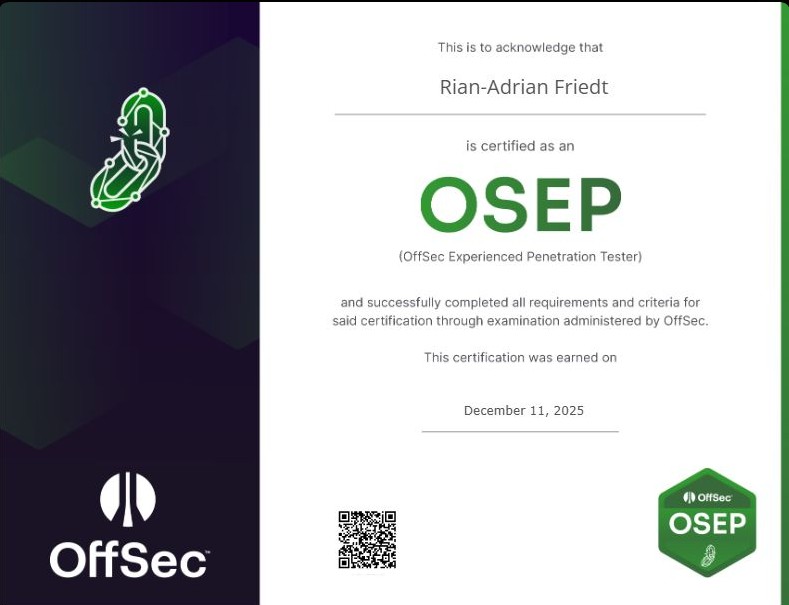
After the Exam
The exam itself felt controlled. I finished the main work in about 7 hours, even though I went into it with very little sleep. That does not mean everyone will have the same experience. Background matters a lot. For me, CAPE had already covered much of the enumeration discipline, Active Directory reasoning, chaining mindset, and note-taking structure that OSEP expects. Because of that, I did not spend months living inside the course material. I focused on the parts that were new or weak for me and then validated them in labs.

Meme note: When the prep is harder than the actual fight, the exam starts feeling less like a monster and more like a checklist with attitude.
The biggest lesson for me was that OSEP rewards calm execution more than panic creativity. If you understand your lab work, keep clean notes, and know how to troubleshoot without losing time, the exam becomes much less chaotic. My strongest recommendation is to take the challenge labs seriously. They are where you find out whether your workflow is actually reliable or only looks good in notes.
I also noticed that not every module or topic needs the same depth for every person. Some areas were essential for my workflow, while others were useful context rather than something I had to over-study. The important part is knowing your own weak points and validating them in a lab instead of blindly collecting more material.
I am grateful for the opportunity to pursue this certification and for the people around me who supported the process. My family, my wife, and MindBytes GmbH gave me the space, motivation, and support to keep pushing my offensive-security path forward.
Looking back, OSEP was less about proving that I can run a specific technique and more about proving that I can stay methodical when Windows, tooling, and assumptions do not behave perfectly. That is the part I will actually carry into real work.
Why I Went for OSEP
After OSCP, CPTS, CAPE, and a lot of AD-focused practice, I wanted something that would validate my Windows tradecraft, payload adaptation mindset, and reporting discipline from another angle. OSEP also looks great on a resume, and the name carries weight. But I would not describe it as a monster certification if you already come from a strong Active Directory and lab-heavy background.
For me, the real goal was not only passing an exam. The goal was becoming more comfortable with the uncomfortable parts: things breaking, payloads failing, assumptions being wrong, and needing to explain the whole chain clearly afterward.
The Prep Mindset
The biggest shift was moving from checklist mode into operator mode. A checklist is useful, but OSEP prep punishes shallow repetition. If something fails, you need to know whether the issue is architecture, context, permissions, language, delivery, detection, or just your own notes being messy.
- Build a repeatable workflow instead of relying on one favorite trick.
- Understand why a technique works before trying to adapt it.
- Treat every failure as feedback from the environment, not as random bad luck.
- Keep a clean lab journal: what changed, what failed, what worked, and why.
- Practice reporting while practicing exploitation, not only after the exam.
What Helped Me Most
1. A Real Windows Lab
The most useful prep was not reading another list of commands. It was testing ideas in an isolated Windows lab until I understood the constraints. If a technique only works when everything is perfect, it is not a workflow. It is a lucky demo.
2. Active Directory Repetition
OSEP and AD are not the same thing, but AD thinking helped a lot: enumeration discipline, privilege relationships, lateral movement logic, and not trusting the first obvious path. Zephyr was useful for that because it trained me to think in longer chains and stay organized.

3. Evasion as Reasoning, Not Magic
The modern evasion topic is easy to explain badly. I do not see it as “use this trick and win.” I see it as understanding how controls reason about behavior, why suspicious patterns stand out, and how defenders can validate that their coverage is not only signature-based. That mindset is much more useful professionally than publishing a fragile bypass recipe.
Defensive takeaway: If a tester can reason about behavior, defenders should reason about behavior too: process chains, memory behavior, scripting patterns, unusual authentication, and the gap between alert volume and actual visibility.
My Study Structure
My preparation was much lighter than the typical “lock yourself in the course for months” roadmap. I only looked at four modules in depth, because CAPE and my AD-heavy practice already gave me most of the knowledge I needed. Instead of trying to consume everything, I treated prep like gap analysis: find the weak parts, test them in a lab, fix the notes, repeat.
- Phase 1: compare the syllabus against what I already knew from CAPE and AD labs.
- Phase 2: study only the modules where I saw real gaps instead of forcing myself through everything.
- Phase 3: spend more time in challenge labs than in passive reading.
- Phase 4: practice chaining, troubleshooting, screenshots, and report evidence under time pressure.
- Phase 5: final review of notes, common failure modes, and clean decision-making under stress.
Meme break: Payload fails silently. Me: “Maybe it is the environment.” Also me: forgot one tiny assumption from three pages ago.
What I Would Do Differently
I would start writing exam-style notes earlier. Not because the report is difficult to format, but because evidence quality becomes much easier when you train it from the beginning. Screenshots, timestamps, clear commands, and short explanations save you from future-you.
I would also spend less time hunting for perfect external resources and more time repeating the same concepts until they felt boring. Boring is underrated. Boring means you can perform under pressure.
Exam-Day Lessons Without Spoilers
- Do not let one failed path destroy your rhythm.
- Keep your notes structured even when you are tired.
- Take screenshots earlier than you think you need them.
- Separate assumptions from confirmed facts.
- If something feels too messy, step back and rebuild the chain in plain language.
Who Should Take OSEP?
OSEP makes sense if you already have a foundation in penetration testing and want a respected certification around Windows-heavy offensive work, payload adaptation, Active Directory-style thinking, and reporting under pressure. If you already finished CAPE or spent serious time in AD challenge labs, I would not treat OSEP like an unbeatable monster. If you are still building fundamentals, I would not rush it. Build the base first, then use OSEP to sharpen and validate your workflow.
Final Thoughts
OSEP is a strong certification and it looks good on paper, but for me it was not the hardest step of the journey. CAPE and long AD lab work prepared me extremely well. The value of OSEP was confirmation: my Windows workflow, notes, troubleshooting, and reporting process were mature enough to hold under exam pressure. That is still a valuable result, even if the cert felt less scary than its reputation.