Before CAPE, I thought I understood Active Directory pretty well.
After CAPE, I realized that Active Directory is not just users, groups, permissions, trusts, Kerberos, certificates, and a few spicy BloodHound edges. It is more like a haunted enterprise building where every door has a delegation setting, every hallway has inherited permissions, and somewhere in the basement there is a service account from 2014 that nobody wants to touch.
And somehow, I love it.
CAPE was the hardest and most rewarding certification I have done so far. Not because every single step was technically impossible, but because the exam forced me to work like a real AD pentester. It punished assumptions, bad notes, tool addiction, weak enumeration, and the very dangerous mindset of „this graph looks nice, so it must be the path.“
This is a no-spoiler review. I will not talk about exam paths, flags, private tasks, or anything that would ruin the experience. This post is about preparation, mindset, pain, community, methodology, and why CAPE changed the way I work in Active Directory environments.
For context: Hack The Box describes CAPE as a hands-on Active Directory certification with a 10-day exam window, an internal foothold, flags, and a professional pentest report. That matches how it felt to me: less like a puzzle box, more like a real internal AD engagement where your process matters as much as your technical knowledge.
The Feeling After Passing
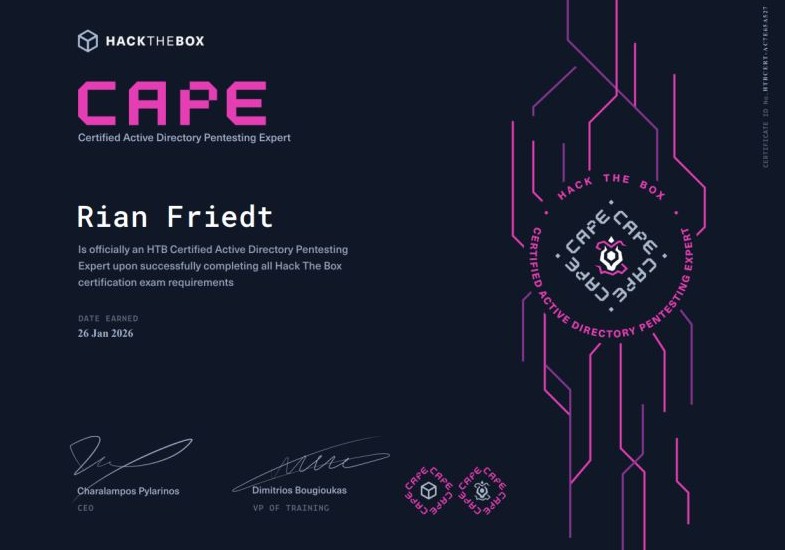
Passing CAPE felt amazing.
For a short moment, I really felt like I had killed the final boss. I was tired, proud, happy, and completely convinced that I had just finished one of the most intense certification experiences of my life.
Then the second phase started.
The result of grinding more than 15 hours a day for seven days straight hit me hard. Mentally, I felt great because I had passed. Physically, I was completely cooked. I still have RSI symptoms from that period, and I do not say that as a funny throwaway line. I genuinely struggle with stepping away from the PC when I am locked into something, and CAPE made that weakness very obvious.
That was one of the most unexpected lessons of the exam. Long practical certifications do not only test your technical skills. They test your setup, your pacing, your posture, your sleep, your breaks, your note-taking workflow, and whether your wrist is still willing to be part of the team after day four.
I passed CAPE, but my body definitely opened a ticket against me.
CAPE Is Not a Trick Exam
The thing I liked most about CAPE is that it did not feel like an exam built around cheap tricks.
It felt like an Active Directory environment that wanted to know whether I could actually think.
That is a very different kind of difficulty. A trick exam makes you feel like you missed one magic command. CAPE felt more like a long conversation with the environment. Sometimes the environment answered clearly. Sometimes it answered like a senior sysadmin who has seen too much and refuses to explain the network diagram.
The hard part was not always exploitation. The hard part was understanding what mattered, what was noise, what was confirmed, and what was only a theory I wanted to be true because I had already spent too much time on it.
CAPE rewards patience. It rewards evidence. It rewards people who can look at a messy domain and slowly turn chaos into a map.
It does not reward panic-clicking through tools and calling that methodology.
PowerView Taught Me More Than BloodHound
One of the biggest lessons CAPE gave me was that manual enumeration is not optional. For me, PowerView became one of the most important tools in the whole process because it forced me to actually understand what I was looking at.
BloodHound is useful. I am not going to pretend it is not. SpecterOps describes BloodHound as using graph theory to reveal hidden and often unintended relationships in Active Directory and Entra ID. That is exactly why it is powerful. It can visualize relationships, reveal interesting paths, and help you understand how objects are connected.
The problem starts when you treat BloodHound like an answer instead of a map.
That is the recipe for failure.
A graph can show you an edge, but it does not always tell you whether that edge is practical, stable, relevant, exploitable, or even worth your time in the current context. CAPE made that painfully clear. If you only follow the prettiest BloodHound path, you might spend hours chasing something that looks good visually but gives you nothing useful in practice.
PowerView felt different because it made the environment slower, but clearer. The PowerSploit documentation describes PowerView as a PowerShell tool for network situational awareness on Windows domains. That is exactly how it felt during CAPE prep: slower than clicking through a graph, but much better for building understanding.
Instead of jumping from one edge to another, I had to ask better questions. Who owns this object? Which permissions are actually assigned? Is this inherited? Is this delegated? Which group membership matters here? What can this user really do, and what can I prove?
That manual process is where AD starts to click.
BloodHound can help you see the forest, but PowerView teaches you how to inspect the trees without getting lost. CAPE rewards that kind of understanding. It does not reward people who upload data, click the shortest path, and pray that Active Directory behaves like the graph promised.
My biggest advice for CAPE preparation is simple: do not make BloodHound your brain. Use it as support, not as your methodology. Learn to enumerate manually with PowerView, understand the relationships yourself, and only then use BloodHound to validate, visualize, or cross-check what you already suspect.
If BloodHound is your starting point and your ending point, CAPE will humble you.
If PowerView is part of your daily workflow, CAPE starts to become much more readable.

Enumeration Is the Main Fight
Before CAPE, I already knew that enumeration was important.
After CAPE, I understood that enumeration is basically the whole game.
There is a huge difference between collecting information and understanding information. You can dump users, groups, sessions, ACLs, SPNs, shares, certificate templates, trusts, computers, and every other object the environment gives you. If you do not understand how those pieces connect, you did not build an attack path. You built a screenshot museum.
CAPE forced me to slow down and ask better questions.
Why does this user have access? Where does this permission come from? Is this relationship direct, inherited, delegated, nested, temporary, or only useful when combined with something else? Can I prove impact, or am I just excited because the output looks interesting?
That last question matters more than people want to admit. A result can look interesting and still be useless. A path can look boring and become important later. A permission can look small until you understand where it leads.
That is the kind of thinking CAPE trains. It pushes you away from „I ran the tool“ and toward „I understand what this means.“
The Real Enemy Was Context
CAPE did not beat me with one giant wall.
It tried to beat me with context.
You need to remember what you tested, what failed, what worked, what might matter later, what you already proved, and what you only assumed because you were tired and wanted the path to be real. That mental load is what makes the exam exhausting.
In a normal lab, you can sometimes survive with messy notes and vibes. In CAPE, vibes are not a methodology. If your notes are weak, you will eventually punish yourself. You will retest the same thing, forget why you ignored something, and stare at your own screenshots like they are encrypted evidence from a crime scene.
Clean notes saved me more than any single tool.
Not pretty notes. Useful notes.
I needed notes that told me what I tested, why I tested it, what the result meant, and whether the finding was confirmed or still only a theory. That distinction became extremely important. CAPE made me much better at separating facts from ideas, and that is a skill I now use constantly in real work.
Active Directory Has a Sense of Humor
The funniest and most painful part of CAPE is that Active Directory sometimes behaves like it knows exactly how much hope you have left.
You find something interesting, and for ten minutes you feel like a genius. Then you test it properly and realize the impact is smaller than expected. Later, the same object becomes relevant again from a completely different angle, and suddenly you are apologizing to an ACL you insulted three hours earlier.
That is the kind of exam CAPE is.
It is not always a clean line from foothold to objective. It is more like slowly building a conspiracy board, except the conspiracy is real, the domain is angry, and your wrist has started negotiating for workers‘ rights.
This is also why CAPE made me better. It trained me to stop treating failed paths as wasted time. If I understood why something failed, it still improved my map of the environment. A failed path can tell you what the environment is not, which permissions are not useful, which assumptions were wrong, and where I should look next.
A beginner sees a failed path and thinks, „I wasted time.“
CAPE teaches you to think, „Good, now I know more than before.“
Why CAPE Hit Harder Than Expected
CAPE hit hard because it exposed shallow knowledge immediately.
If I only knew a tool name, that was not enough. If I only knew a technique from a writeup, that was not enough. If I only knew that a permission was „interesting“ but could not explain the actual impact, that was not enough.
The exam forced me to understand the relationships behind the attacks. Active Directory stopped looking like a list of techniques and started looking like a system of identity, access, delegation, authentication, and historical chaos.
That last part is important. Real AD environments are not clean. They have legacy systems, old admin habits, strange group nesting, unclear ownership, service accounts nobody wants to touch, and permissions that exist because „it fixed something in 2016.“
CAPE felt valuable because it trained me for that kind of mess.
Not a perfect lab.
A believable mess.
The Year of AD Pain
CAPE was not a quick weekend project for me.
It was roughly a year of focused Active Directory work, HTB Academy progress, lab time, note refinement, mistakes, rabbit holes, frustration, and slowly building the confidence to look at a domain without immediately feeling overwhelmed.
Some days were great. Other days were just me discovering that I had misunderstood something I thought I understood.
That is not always fun, but it is one of the best ways to improve. CAPE does not let weak understanding stay hidden for long. If your foundation is shaky, the material will find it. If your methodology is messy, the exam will make you pay for it. If your notes are bad, your future self will become your enemy.
Over time, AD became more readable.
DACLs stopped looking like random noise. Trusts started making more sense. Enumeration became less of a checklist and more of a conversation. I started caring less about whether I could force a path and more about whether I could explain why a path existed.
That shift was the real value.
The Community Made It Sustainable
One thing I will always appreciate about the CAPE journey is the community around it.
Hard certifications can feel isolating. You spend hours alone in labs, hit weird problems, doubt your notes, fix one thing and break another, and eventually start wondering whether everyone else is secretly having an easier time.
Having people around the grind changed the experience.
It was not about sharing spoilers or shortcuts. That would ruin the point of the certification. It was about motivation, frustration, small wins, bad jokes, and those moments where someone finally understands an AD concept after staring at it for way too long.
That made the journey more human.
CAPE was still hard, but it felt less lonely.
The certification gave me technical growth. The people around the process made the grind sustainable.
CAPE Compared to My Other Certs
Every certification gave me something different.
OSCP gave me persistence. It taught me how to keep going when things do not work and how to survive the grind.
CPTS gave me methodology and structure. It helped me become more systematic and more comfortable with practical assessment work.
OSEP validated Windows tradecraft and exam execution. It made me better at working under pressure in a Windows-heavy offensive environment.
CAPE gave me Active Directory confidence.
That is why I rate it so highly. It did not just add another badge to my profile. It changed the way I approach the kind of work I actually care about.
After CAPE, AD environments felt less random. They are still messy, still painful, and still full of surprises, but they feel manageable. I can break them down, map relationships, validate impact, and explain risk in a way that makes sense.
That is worth more than the certificate itself.
What I Would Do Differently
The first thing I would do differently is protect my body better.
I know that sounds funny in a technical review, but I mean it seriously. Grinding more than 15 hours a day for seven days straight was not healthy. Passing felt amazing, but dealing with RSI symptoms afterwards was not part of the achievement I wanted.
I would take more structured breaks. I would fix my desk setup earlier. I would stretch. I would stop pretending that „just one more hour“ is a time management strategy.
I would also prepare my documentation workflow earlier. Not just notes for learning, but exam-style evidence. Screenshots, short explanations, clear impact statements, and a structure that still makes sense when I am tired.
CAPE is technical, but it is also about communication. Finding impact is one part. Proving it clearly is another.
Who Should Take CAPE?
Take CAPE if you want to become genuinely strong in Active Directory penetration testing.
Not „I know some tool names“ strong.
Not „I followed one writeup once“ strong.
Actually comfortable in AD environments strong.
I would not recommend rushing it without fundamentals. You should already be comfortable with Windows, networking, privilege escalation, methodology, reporting, and the reality that enumeration is where most of the work happens.
CAPE is hard, but it gives back a lot if Active Directory is something you care about. It made me better at reading environments, validating assumptions, documenting impact, and staying calm when a path collapsed.
Most importantly, it made me respect AD even more than before.
Final Thoughts
CAPE is still the certification I respect the most from my own journey.
Not because it was the flashiest. Not because it was easy to talk about online. Not because the badge magically changes anything.
I respect it because it changed how I work.
It made Active Directory feel readable. It forced me to slow down, think properly, document clearly, and stop confusing tool output with understanding.
It also gave me a community, a lot of painful lessons, and RSI symptoms that still remind me that my biggest vulnerability might be my inability to leave the PC when I am locked in.
So yes, CAPE felt like killing the final boss.
But the real lesson came after the boss fight: passing is great, but surviving the grind in a healthy way matters too.
If you are on the CAPE path, take your time, build your methodology, write useful notes, do not underestimate the report, and please take care of your body before your wrist starts its own incident response process.
Podcast About CAPE
I also talked about my CAPE experience on the Schlopshow.
If you want a more relaxed, no-spoiler discussion about the preparation, mindset, AD pain, and what the exam felt like, you can watch it here:
Feel free to join our study group for CAPE or ask questions here:
Join the Discord